Middletown, NJ · Garage Door Service
Red Bank homes date mostly to 1955, older than most of the area's 1960s-70s stock. Original hardware plus cold winters means specific failures. Service runs from Middletown, 4 miles out.
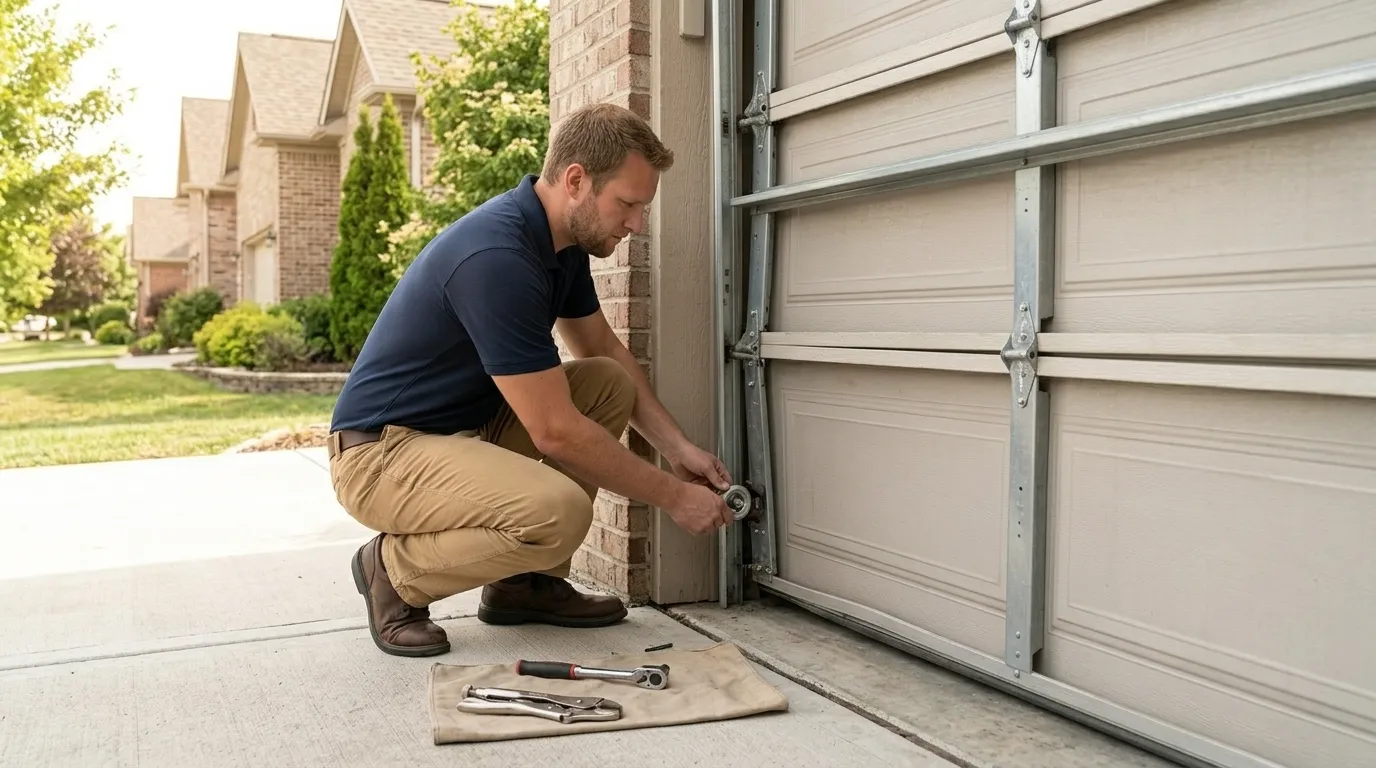
Red Bank's housing stock centers on 1955, which puts it ahead of the 1960s-70s wave that makes up most of the surrounding service area. That gap matters more than it sounds. A door and opener installed in 1955 has had two extra decades to sit in a garage before anyone thought to swap the springs, and in a lot of these houses, nobody ever did. The bracket, the hinges, the cable drum - if the house hasn't been through a full door replacement, there's a real chance the hardware holding that door up right now is original.
That's not a scare line, it's a maintenance gap. Torsion springs are rated for a number of cycles, not a number of years, but age still counts against steel that's been through decades of this region's cold-severe winters. Cold makes lubricant thicken, metal contract, and springs that were already near the end of their life snap on the coldest morning of the year - not the day you noticed the door felt heavy. If your house in Red Bank is from the 1950s and the springs look original, they're closer to failure than a 1970s door with the same symptoms, simply because they've had more winters to work against.
This job is covered out of Middletown, about four miles from Red Bank. There's no branch or drop-off point here - a truck comes from Middletown for every call, so plan the visit around that distance rather than expecting a walk-in counter nearby. Tell whoever answers the phone the age of the house if you know it; on a 1955-era door, that one detail changes what parts get loaded on the truck before it leaves.
If the door won't open at all, mention that up front too - a jammed door on a house this age is more often a broken spring or a snapped cable than an opener problem, and knowing that in advance saves a second trip.
The most common trap on a 1955 door is discovering, mid-repair, that the track or the hinges have been bent and re-bent so many times over seventy years that a spring swap alone won't fix the real problem. The door looks like it needs one part until the panel comes off true and you can see the track is out of plumb by enough that the rollers were never going to run smooth again.
Cold makes this worse. A door that's been dragging on a bent track all summer can seize hard on a freezing morning, and what would've been a simple adjustment call turns into a full hardware replacement because something finally gave. On houses this old, it's worth checking the track and hinges even when the spring looks like the obvious culprit - fixing the spring and sending the truck home without checking the rest means a callback.
For a house built around 1955, the springs and rollers on the truck are sized for older torsion setups, not just the newer standard doors that cover most of the rest of the area. That's worth knowing before you call, because the honest limitation here is lead time: if a part turns out to be a size or style that isn't on the truck - some of these older doors used hardware that isn't common anymore - it may take an extra trip to get the right piece rather than force a fix with something close enough.
Rollers, cables, and standard torsion springs for a door this age are usually in stock. What sometimes isn't is an exact-match panel or an original-style hinge, especially if the door itself was never replaced and the rest of the hardware is non-standard to match it. Better to say that up front than to promise a same-visit fix on a part that has to be ordered.
On a house from the 1950s, the door that suddenly feels heavy to lift by hand, or won't stay up on its own, is almost always the torsion spring losing tension - and on a door this age, that spring has likely never been swapped. A loud bang from the garage, followed by the door refusing to open, is usually that spring finally breaking rather than fraying gradually.
A door that runs rough, grinds, or catches partway up more often points to the track or rollers than the spring - and on 1950s hardware, that roughness has usually been building for years, not weeks. If the opener runs but the door doesn't move, check the cable before assuming the motor's the problem; on older setups the cable is frequently the weaker link.
Don't touch the torsion spring. It's under enough tension to break a bone or worse, and on a door this old, the spring is holding more stress for longer than it was rated for, which makes it less predictable, not more. That's the one job to leave alone regardless of how simple it looks.
What you can check yourself: the tracks for visible bends, the rollers for cracking or flat spots, and whether the door is balanced by disconnecting the opener and lifting by hand - it should stay roughly level on its own. If it drops or shoots up, the spring's off and it's a call, not a DIY fix. Lubricating hinges and rollers with a garage-door-specific spray is fine and worth doing twice a year, especially heading into winter.
If the house dates to around 1955 and the spring has never been replaced, an adjustment usually isn't the answer - the steel has had seven decades of cycles and cold winters against it. At that point a full spring replacement is more honest than trying to stretch a few more months out of tired hardware.
No. This service runs out of Middletown, about four miles from Red Bank. There's no separate branch here, so every call is a dispatch from Middletown rather than a nearby drop-in visit.
Cold makes old steel more brittle and lubricant thicker, so a spring that was already near the end of its life on a house this age tends to give out on the coldest days rather than gradually. It's rarely random - it's decades of cycles finally catching up in weather that adds extra stress.
Call now or request a free quote - same-day service on most repairs, upfront written pricing.