Middletown, NJ · Garage Door Service
Red Bank's garage doors mostly date to the mid-1950s, older than the service area average. Here's what that means for roller wear, and how Middletown Garage Door Pros handles the job.
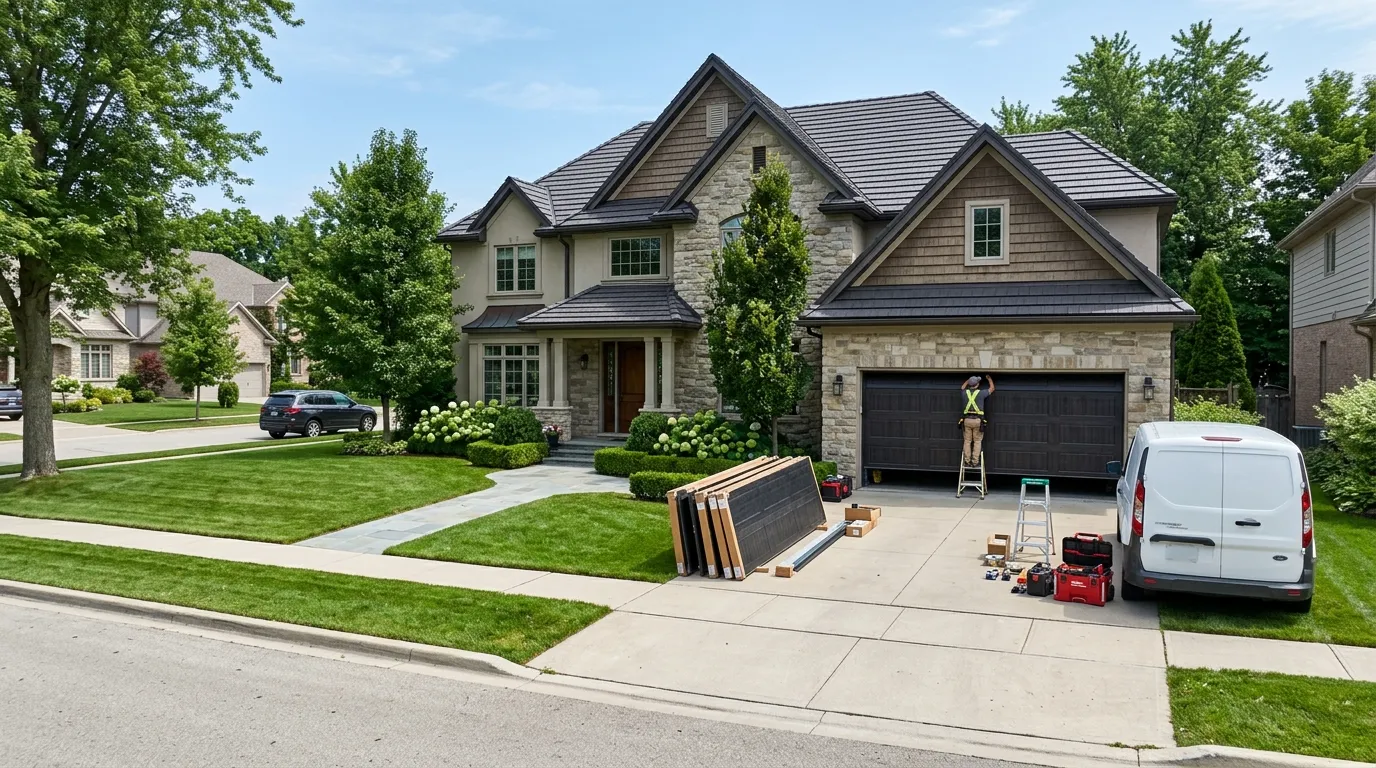
The fault we see most in Red Bank isn't a broken cable or a dead opener - it's rollers that have simply worn past round. Most houses on this side of Red Bank went up around 1955, a decade before the wider service area's median build year of 1962. That matters because doors from that era were hung with narrower track gauges and steel rollers on longer stems, not the sealed nylon rollers that showed up in later remodels.
Steel rollers on old track wear a groove into themselves over enough winters, and once that groove gets deep enough the roller starts binding instead of turning. You hear it before you see it - a flat, dragging sound instead of a smooth roll. On a door this age, that wear is often paired with a track that's slightly bowed from decades of the same worn roller riding the same spot, which is a separate problem that roller replacement alone won't fix.
At a median household income of $101,738, Red Bank runs below the wider area's $113,229 median, and in our experience that tracks with more owners running original rollers well past the point we'd normally recommend swapping them, rather than replacing early. That's not a criticism - it's just why the rollers we pull out of Red Bank garages tend to be in worse shape than the ones we pull out elsewhere on the route.
Middletown Garage Door Pros doesn't keep a branch in Red Bank - the truck comes from the Middletown shop, four miles up the road. That's one of the shorter runs on our territory, closer than stops like Colts Neck or Tinton Falls, but we're not going to promise a same-day slot here that we can't promise anywhere else on the list.
What we can tell you is what to have ready when you call: the age of the house if you know it, whether the door sticks on one side or drags evenly, and whether you're hearing the noise on the way up, the way down, or both. That narrows down whether this is a roller job on its own or a roller-plus-track job before anyone drives out.
For general service in the area, see Red Bank garage door service. If you're comparing this against the roller work we do out of the home base, the Middletown roller replacement page covers that side of it.
The job goes sideways when a roller swap gets treated as a standalone fix on a door where the track has already taken damage from the old roller. Replace the roller and leave a bowed track section in place, and the new roller wears the same uneven path the old one did - just faster, because the new hardware is tighter tolerance than what it's replacing.
It also goes sideways on the top rollers specifically. On a lot of these 1955-era doors, the top roller sits close to the spring assembly, and pulling it means working near a torsion spring that's still under load. That's not a job to start and stop halfway through - once the track bracket is loose, the door isn't stable until it's back together.
The honest limitation here: if we get out to a job and find the track itself is bent rather than just worn, roller replacement stops being the fix. At that point we're talking about a track section, sometimes the full track, and that's a different estimate than what got booked. We'd rather tell you that on-site than swap rollers into a track that's going to chew through them again in a year.
We carry the common roller sizes - both nylon and steel, in the stem lengths that fit most doors from the 1938-2005 build range this area falls into. For a straightforward swap on a standard double or single door, that's usually a same-visit job once we're on site.
Where it slows down is the older stem lengths specific to houses built closer to that 1955 mark. Some of those doors were hung with hardware that isn't a stock size anymore, and if the stems on your door fall into that category, we may need to order the exact match rather than force a near-fit that'll bind again in a season.
We'd rather say that upfront than tell you it's a quick fix and then call you back with a delay. Nylon rollers are the better call for anyone doing a full replacement rather than a spot fix - they run quieter and don't develop the same flat spots steel rollers do over time, which matters more here given how many original steel rollers are still in service on this side of town.
If the door is grinding on the way up, or you hear a rhythmic thump that matches the door's speed rather than a single bang, that's usually a roller that's gone flat on one side or cracked at the bearing. A door that sticks at the same spot every time, rather than dragging the whole way, points to one bad roller rather than a full set worn evenly.
A door that's noticeably louder in winter than summer is worth paying attention to. Cold makes old grease stiffen and steel contract slightly inside the roller housing, so marginal rollers that were tolerable in warmer months start binding once temperatures drop. That's less about any one roller failing and more about hardware that was already near the end of its life getting pushed over the edge.
Rust streaks on the track itself, right where the roller rides, usually mean the roller's bearing seal failed a while ago and it's been running dry. By the time you see that, the roller's usually due for replacement regardless of how it sounds.
Bottom rollers on a lot of these doors are within reach for a homeowner comfortable with a wrench and a ladder - they're not under spring tension and the roller bracket usually comes off without disturbing anything else. If you're only replacing one or two bottom rollers on a door that's otherwise tracking straight, that's a reasonable weekend job.
Top rollers are a different call. On these older doors especially, the top roller bracket sits near the torsion spring assembly, and that spring stays under load whether the door is up or down. We don't recommend homeowners work near it without the right bar and clamps, and we won't walk someone through it over the phone - that's the one place we draw a hard line.
If you're not sure whether what you're looking at is a bottom roller or something closer to the spring, send us a photo before you start pulling anything apart. That's a five-minute check that saves a trip to the ER for the sake of a $15 roller.
A lot of Red Bank's housing dates to around 1955, older than this area's overall median of 1962. Doors from that era were built with narrower track and steel rollers on longer stems, and steel rollers wear a groove into themselves over enough winters that newer nylon rollers don't develop the same way.
Common sizes, yes - both nylon and steel, in stem lengths that fit most doors from the 1938-2005 range across this area. Some houses closer to the 1955 mark have older stem lengths that aren't a stock size anymore, and those sometimes need to be ordered rather than fitted same-visit.
The truck comes from Middletown, about four miles away. There's no separate branch or depot in Red Bank, so we can't promise a specific response window here - just that it's one of the shorter drives on the route.
Bottom rollers, often yes - they're not under spring tension and the bracket usually comes off cleanly. Top rollers sit close to the torsion spring assembly on a lot of these older doors, and that spring stays loaded whether the door's open or shut. We don't recommend doing that part yourself.
Call now or request a free quote - same-day service on most repairs, upfront written pricing.