Middletown, NJ · Garage Door Service
Strathmore homes went up around 1966, right as steel doors and extension springs took over from wood - that's the hardware our trucks from Middletown see most on this street of the county.
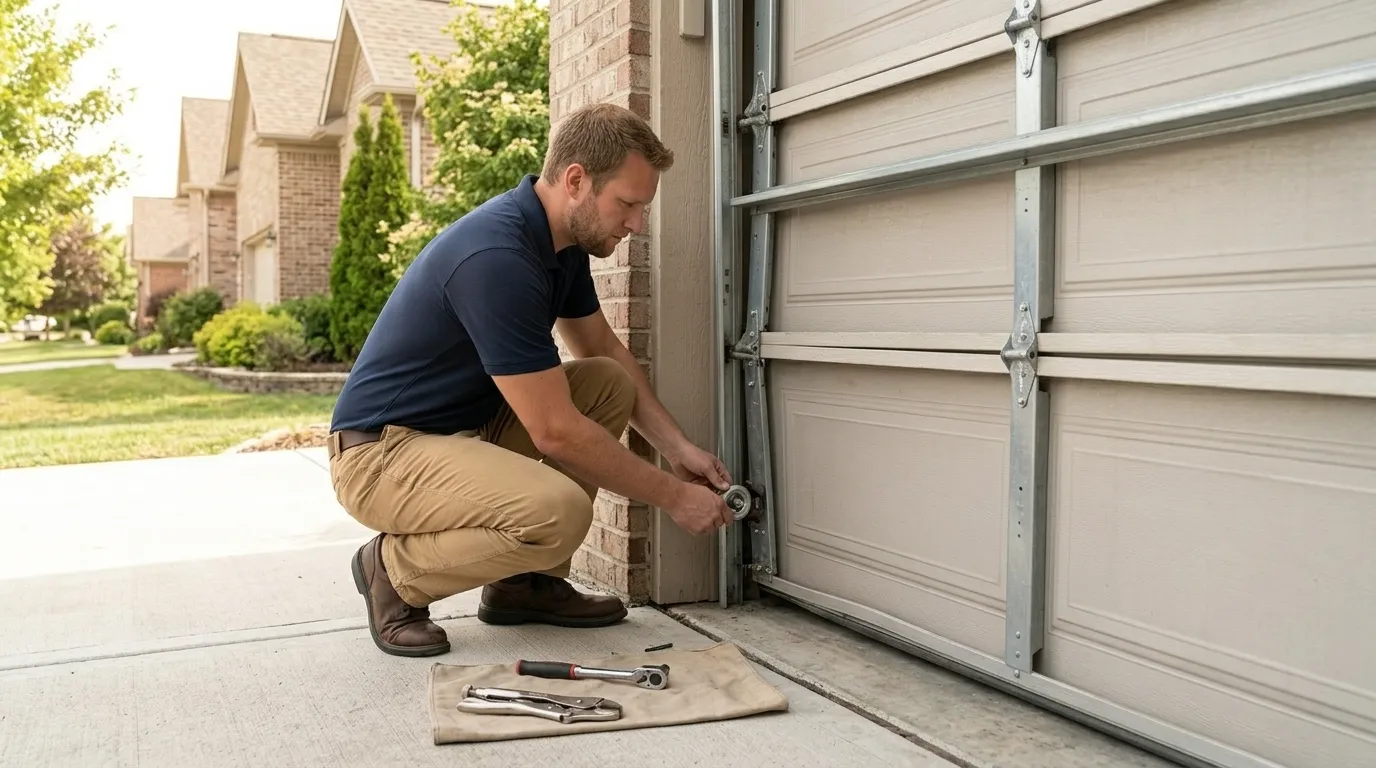
Most Strathmore calls we get involve extension springs, not torsion - a giveaway that the door and track behind it are original to a house built when this pocket of the township went up, around 1966. That's a full decade earlier than a lot of newer construction further out, and it means the hardware is a different generation. Extension spring jobs run faster than torsion conversions because there's no need to reset drums or measure new cable drop, but a swap to torsion (which we recommend on doors over a certain weight or width) adds time for reinforcement bracket work on the header.
We travel the 6 miles out from Middletown for every Strathmore call, so nothing here is same-day guaranteed - we tell you a window when you call, not before. What we can say is that once the truck's on site, a spring job on this era of door is usually a same-visit fix, parts allowing. Openers are the wildcard: chain-drive units from a 1990s or early-2000s retrofit on these houses often need a logic board or a full unit, and that's not a five-minute part.
The trouble spot on a Strathmore door isn't usually the spring itself - it's the track alignment underneath it. Houses built in the mid-1960s got steel doors on steel track bolted to wood jambs that have moved slightly over sixty years of frost and thaw. You get a door that runs fine for years, then one cold morning the roller catches a lip in the track that wasn't there the season before, and the extension spring - already working harder because the door isn't sliding true - snaps.
We also see cable fraying at the bottom bracket more often here than on newer stock, because the original brackets weren't galvanized to the standard used today. It's a small thing until the cable goes and the door drops unevenly on one side.
We don't publish a price list for this page because door width, spring count, and whether the opener needs work all move the number, and we're not going to give you a figure that doesn't hold once the truck's in your driveway. What we will tell you: extension spring replacement on a standard single is a smaller job than torsion conversion, and torsion conversion is a smaller job than a full door replacement. If your Strathmore door is the original steel panel from the 1966-era build, replacement panels for that width aren't stocked anywhere - we can source close matches, but an exact match isn't realistic after this many decades.
Extension springs are the one place homeowners get hurt trying a DIY fix, because the spring is under tension even when the door looks still. If you're comfortable with a ladder and basic tools, replacing rollers or lubricating track is fine to do yourself and won't void anything. Spring replacement, cable work, and anything touching the bottom bracket under load - leave that to a call. It's not about skill, it's about what happens if the tension releases wrong.
One honest note: if your opener is original to a 1990s retrofit and it's just slow or noisy, that's often a lubrication and adjustment fix you could try yourself before paying for a truck to tell you the same thing.
Strathmore sits in a stretch of Monmouth County with a real winter - this whole service area falls in a cold, severe climate band, and that matters more for garage doors than people expect. Steel contracts in the cold, and a door and track set installed in 1966 wasn't built with today's weatherstripping or insulated panel standards. Every freeze-thaw cycle works on the same bolts and brackets a little more, and after enough winters the tolerance that used to keep a door running quiet is gone.
Households in Strathmore run a median income around $155,048, well above the wider service area's $113,229 - which we mention only because it tends to mean owners here replace worn hardware before it fails outright rather than running a door to the point of total breakdown. That changes which jobs we see: fewer full collapses, more "it's getting loud" calls caught early.
On a typical Strathmore extension-spring job, we pull both springs (never just the broken one - the other is aged the same and about to go), check the track alignment against the jamb, and replace the bottom bracket if there's any fraying on the cable. If the track's shifted from decades of settling, we re-square it before touching the spring so the new spring isn't fighting a bad angle from day one.
For the roughly 2,479 households in Strathmore built in this same window, we're seeing similar patterns door to door - which is exactly why a Middletown-based crew that knows the 1960s stock out here does the job differently than a crew guessing at it cold.
If your house dates to the mid-1960s build-out, you likely have extension springs on original steel track. Track that's shifted slightly with age puts uneven load on the spring, which shortens its life. Replacing the spring without checking track alignment usually means you're back to another break within a year or two.
No. We work out of Middletown and drive the roughly 6 miles into Strathmore for calls. There's no local depot, so we quote a time window when you call rather than promising an exact arrival.
Depends on the door. If the panel itself is cracked or badly dented, exact replacement panels for that era aren't stocked anywhere and a full new door often makes more sense than chasing a match. If it's just spring or track wear, repair is usually the cheaper and faster call.
Call now or request a free quote - same-day service on most repairs, upfront written pricing.