Middletown, NJ · Garage Door Service
Emergency garage door repair for Tinton Falls homes, most built in the early 1990s. Middletown Garage Door Pros travels 9 miles out to fix openers and springs fast.
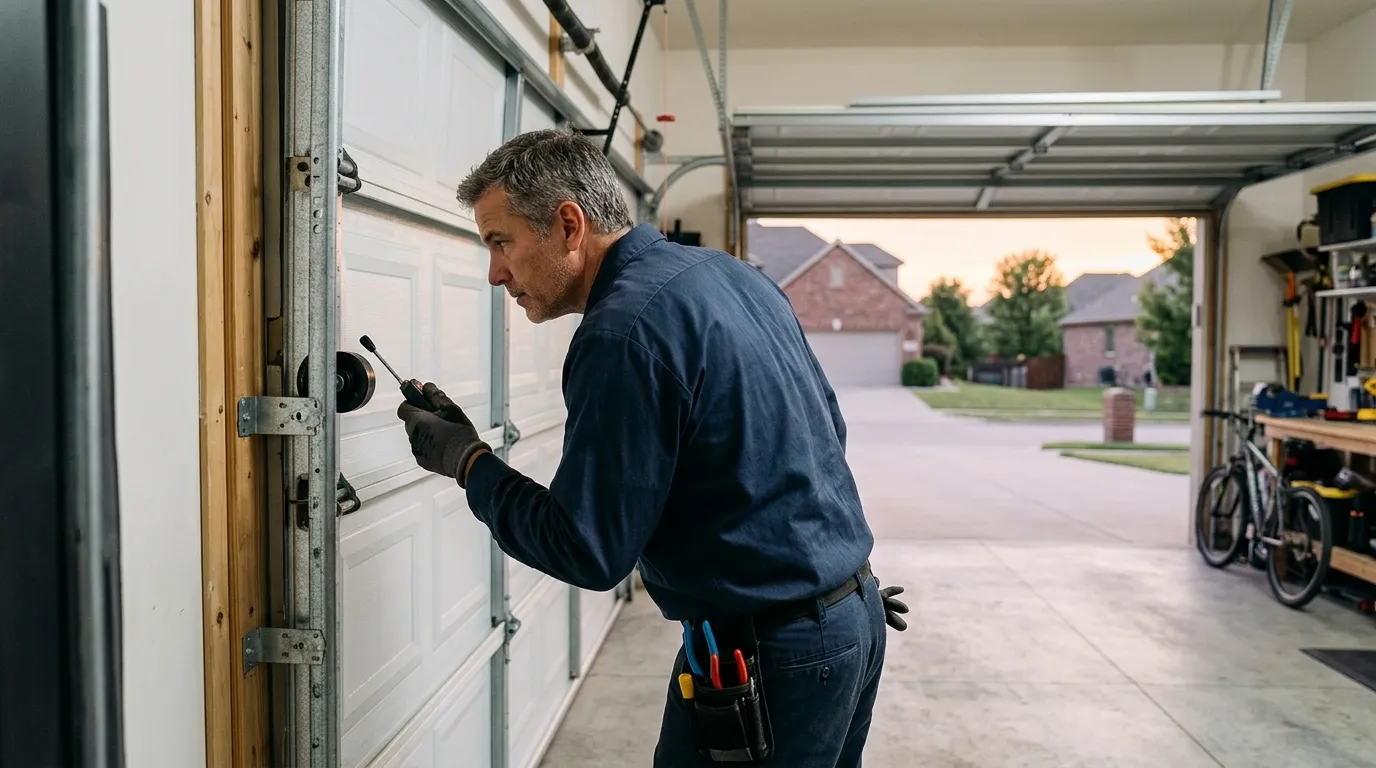
The call we get most from Tinton Falls isn't a snapped spring - it's a dead opener. Houses out here were mostly built around 1992, which puts a lot of original or first-replacement openers well past their working life. Circuit boards fail, drive gears strip on chain units, and the logic board that used to reset with a flip of the breaker just stops responding. That's a different failure pattern than the older housing stock closer to Middletown, where 1960s-era doors and torsion hardware cause most of the trouble.
Because the broader service area's housing runs from 1938 to 2005 with a median build year of 1962, we carry parts for both eras - but a 1992 Tinton Falls job usually means we're pulling newer opener boards and steel roller kits, not the older heavy-gauge torsion springs from the postwar side of the territory. If the opener carriage has sheared or the sensor wiring has corroded at the base, that's an opener-specific fix, not a spring job, and we diagnose accordingly before quoting anything.
One limitation worth saying up front: if the opener motor itself has burned out and the model's been discontinued, we may recommend replacement over repair rather than chase a part that's hard to source.
We come from Middletown, about 9 miles out, so the drive is part of the job, not an afterthought. Once on site, most opener-board or sensor repairs on a 1990s-era door run under two hours, since the hardware is newer and better documented than the older torsion setups closer to home base. A stripped chain gear or a broken trolley usually gets fixed on the first visit.
Where it stretches longer is when the failure is electrical rather than mechanical - a board that's intermittently faulting can take longer to isolate than a snapped spring, because you're testing under load rather than swapping a part you can see is broken. We won't guess at a board replacement without confirming the fault first; that's slower, but it keeps you from paying for a part that wasn't the problem.
The most common misdiagnosis on a Tinton Falls call is treating a dead opener like a spring problem. If a door built in the early '90s won't budge, homeowners often assume the spring's gone, since that's the classic garage door failure story. But on this housing stock, we're just as likely to find a failed capacitor or a stripped drive gear behind a perfectly good spring.
The other place it goes sideways is safety sensors. Doors from this era commonly have photo-eye sensors near the base of the track, and a knocked or corroded sensor reads to the opener as an obstruction - the door reverses or won't close at all, and it looks like a bigger mechanical failure than it is. We check sensor alignment before touching anything else, because replacing an opener over a $20 sensor fix is a bad trade for anyone.
We work Tinton Falls out of Middletown, roughly a 9-mile run, and take the call the same way we would for any household in the wider service area - ask what the door is doing (won't open, won't close, opener dead, grinding sound), and get a truck moving with the right parts loaded for a 1990s-built opener setup rather than guessing on-site. You can see the general service coverage for the area on our Tinton Falls service page, and if you're closer to Middletown itself, the emergency repair page for Middletown covers that older housing stock's specific issues.
Tinton Falls sits at the newer end of the service area's housing range - built around 1992 against a broader median of 1962 across the 76 named communities we cover. That gap matters more than it sounds. Newer construction means steel sectional doors with factory-installed openers and circuit-based safety systems, not the older wood-panel doors and heavier torsion springs found on the pre-1960s side of the territory.
Winters here are the same cold-and-severe pattern as the rest of the region, which still stresses lubricant and metal fatigue regardless of build year, but the failure shows up differently on newer hardware - boards and sensors first, springs and cables second. With median household income locally around $113,800, most owners here are maintaining original or one-time-replaced systems rather than budget builder-grade units, so when something does fail, it's often a part worth repairing rather than a door worth replacing outright.
Doors built around the early 1990s, common in Tinton Falls, usually fail at the opener first - a worn drive gear, a failed circuit board, or a misaligned safety sensor. Springs on this era of door tend to last longer than the opener hardware attached to them, so we check the opener and sensors before assuming a spring has gone.
We run out of Middletown, about 9 miles from Tinton Falls. We don't keep a branch or truck stationed locally, so every call is a dispatched visit rather than a walk-in shop, but parts for newer opener systems ride on the truck for jobs in this part of the service area.
Usually, yes. On doors from this build era, a knocked-out-of-alignment or corroded photo-eye sensor near the base of the track is a common cause of a door that reverses or won't close. It's often a quick fix once we confirm that's actually the fault, rather than a bigger opener replacement.
Depends on the part. If the motor itself has burned out and the model is discontinued, replacement usually makes more sense than hunting down an obsolete board. If it's a gear, capacitor, or sensor, repair is normally the cheaper and faster route.
Call now or request a free quote - same-day service on most repairs, upfront written pricing.