Middletown, NJ · Garage Door Service
Serving Laurence Harbor's 1960s-era homes, 8 miles from our Middletown base. Torsion spring, opener, and track repair for the original hardware still on these doors.
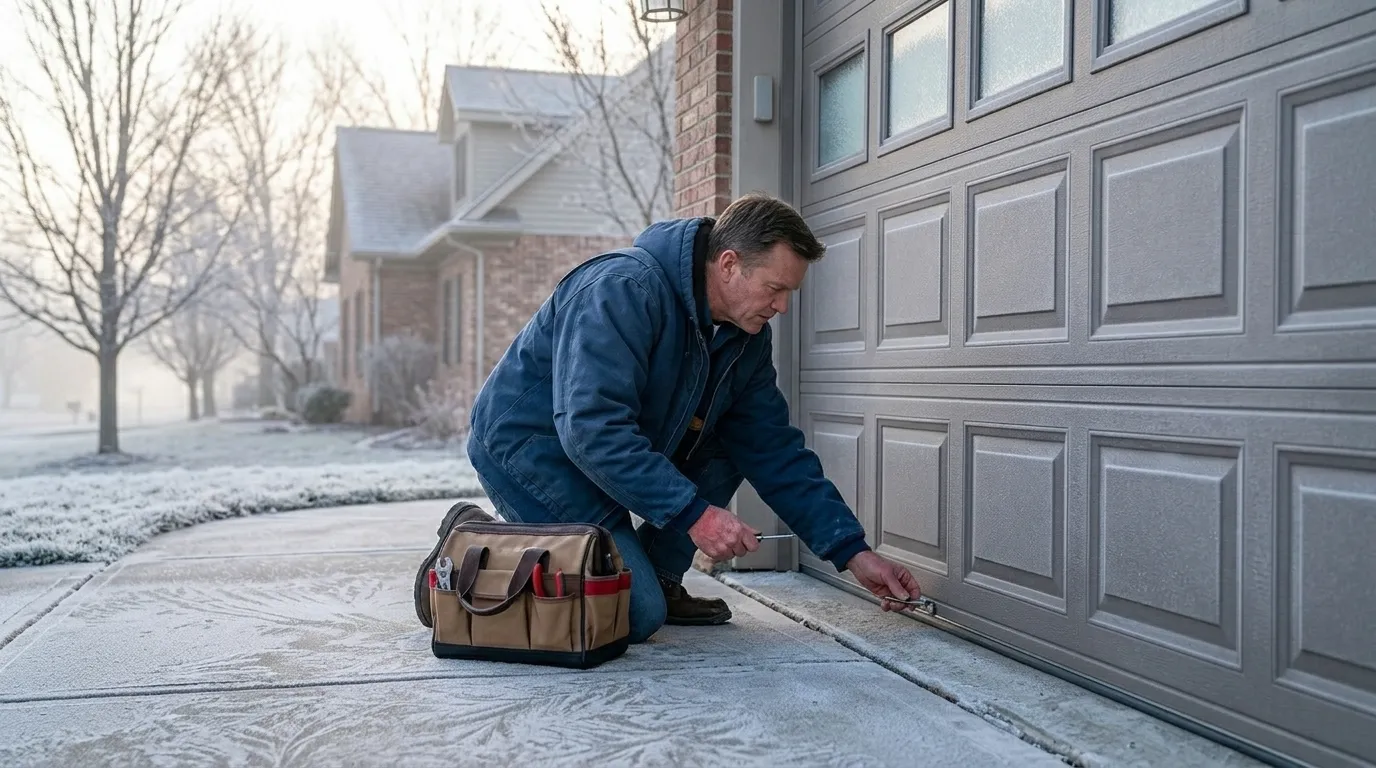
Laurence Harbor's houses mostly went up around 1965, right in the middle of the broader area's 1960s-70s building wave. That matters more than it sounds. A door installed when a house was built in the mid-60s is almost never the door on that house today, but the hardware behind it often is - the same torsion spring anchors, the same track brackets bolted to framing that's now sixty years old. We drive out from Middletown, about 8 miles, and what we see on these calls is original jamb hardware paired with a replacement door that was never quite matched to it. Track alignment drifts. Brackets that were fine for a lighter wood door strain under a heavier steel one.
The cold here isn't mild. This region sits in a severe cold climate band, and steel contracts in ways that expose weak spots - a spring wound to older tension specs, a roller that was never upgraded from steel to nylon, a bottom seal that never sealed well to begin with on a slab that's settled over decades. None of this is dramatic. It's the kind of wear that shows up as a door that's slower, louder, or harder to lift by hand than it used to be, and it traces straight back to hardware that's older than most of the homeowners calling us.
On mid-1960s houses like the ones common in Laurence Harbor, the calls repeat in a predictable pattern. Torsion springs sized decades ago and never re-rated for a heavier replacement door are the single biggest issue - the door either won't stay up on its own or slams down fast because the spring is fighting weight it wasn't built for. Second most common: track brackets loosened from framing that's shrunk and shifted over sixty winters, which throws the whole door out of square even when the panels themselves are sound.
Openers are usually the newest part of the system and the least of the problem, though we do see older chain-drive units straining against the same mismatched spring tension above. Bottom seals and astragal replacement come up often too, since a slab door on an older foundation rarely sits perfectly level anymore. None of this is unique to any one street - it's what mid-60s construction plus decades of New Jersey winters does to a garage door system that's had one or two partial upgrades but never a full hardware review.
Laurence Harbor's housing stock centers on 1965, close to the wider service area's median of 1962, and it sits inside a broader footprint of roughly 380,475 households where 142,391 are owner-occupied houses - most of that stock dating from the 1960s and 70s. Median household income in Laurence Harbor runs around $89,500, a bit below the area-wide figure of $113,229, which is worth mentioning because it shapes the calls we get: more repair requests, fewer full replacements up front, more homeowners asking whether a part can be fixed before they commit to swapping the whole door.
That's a fair question, and often the honest answer is yes. A torsion spring, a section of track, a bent panel - these are usually repairable on a door frame from this era, provided the frame itself is square and the opener still has service life left. The age of the stock cuts both ways: parts on a 1965 door assembly are simple and well understood, but they're also not something every supplier stocks on the truck, which can mean a short wait on an odd-sized part.
We're straight about this because it saves everyone a wasted trip. If a door's track and jamb hardware are bent badly enough that the frame itself is out of square - not just misaligned, but structurally racked - patching the spring or the rollers won't fix the underlying problem, and we'll say so instead of billing for a repair that won't hold. On houses this age, that's not rare; it happens after a door's been forced open or closed while jammed.
We also won't guess at a spring size over the phone for a door we haven't seen. Torsion springs are sized to the door's actual weight, not its age or model number alone, and a wrong guess is a safety problem, not just an inconvenience. We travel from Middletown to reach Laurence Harbor, so we'd rather get the numbers right on the first visit than make a second trip for a swap we should have caught the first time.
Close, but not identical. Laurence Harbor's housing centers on 1965, right in line with the wider area's 1960s-70s stock, though the broader region's median build year runs slightly earlier at 1962. The practical effect is the same either way: original torsion hardware paired with doors that have often been replaced at least once since.
No. We run out of Middletown, about 8 miles away, and travel to Laurence Harbor for calls. We don't advertise a local response time because we're not staged in the area - we schedule the drive like any other job on the route.
On a house built around 1965, the torsion spring was often sized for whatever door was original to the house. If that door's been replaced with a heavier steel model since, the old spring is working harder than it was built for, which shortens its life. Re-sizing the spring to the current door usually solves it.
Depends on the frame. If the jamb and track brackets are still square, repairing springs, rollers, or a bent section is usually the cheaper and faster fix. If the frame itself has racked out of square, repair won't hold and replacement is the honest answer.
Call now or request a free quote - same-day service on most repairs, upfront written pricing.