Middletown, NJ · Garage Door Service
Middletown Garage Door Pros services Port Reading, NJ, about 14 miles out, working on split-level and ranch garages built here since the early 1960s.
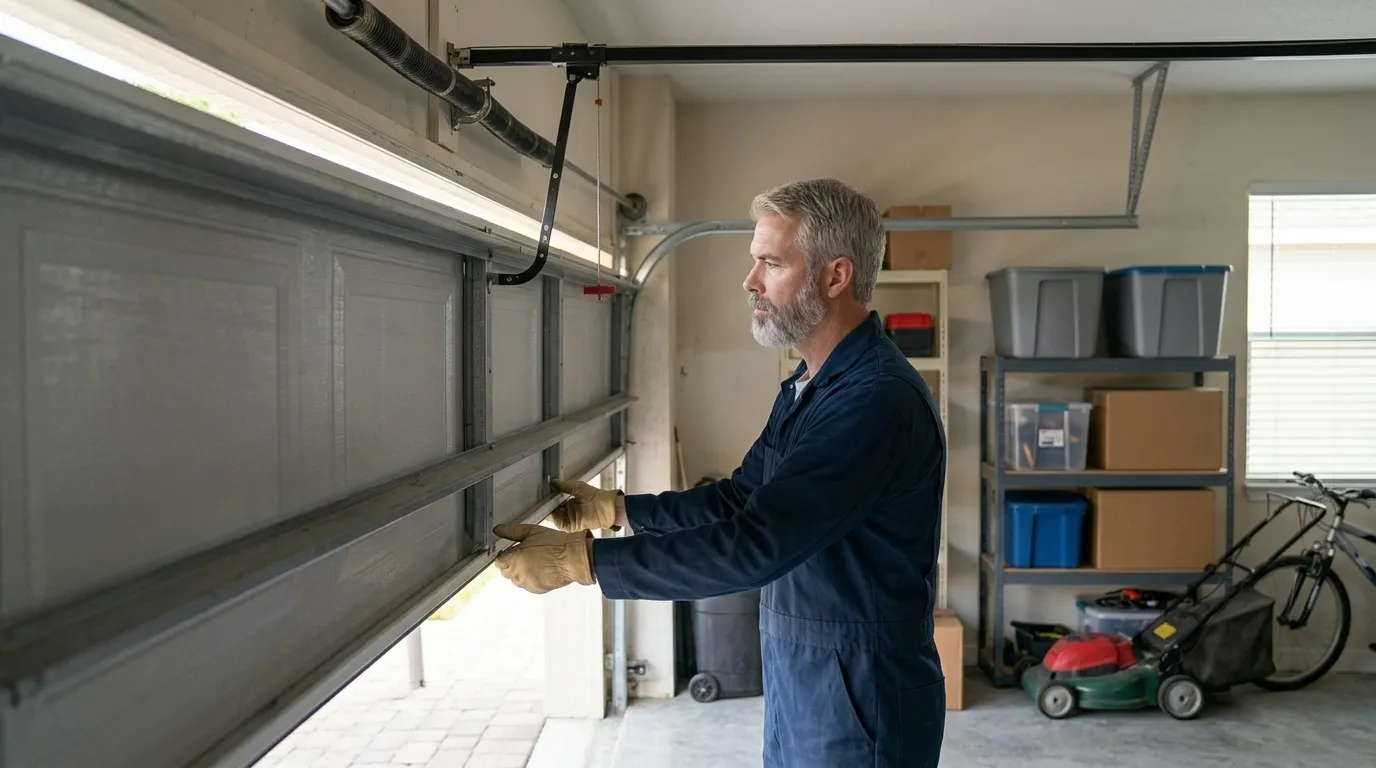
Port Reading's homes mostly went up around 1962, the same building run that shaped most of the wider Middletown service area. That matters more than it sounds like it should. A garage built in the early 1960s usually started life with a single-layer steel or wood panel door, a lightweight torsion spring sized for that lighter door, and track hardware bolted straight to framing that's now over sixty years old. Somewhere along the way a lot of these got upgraded to insulated doors without anyone upsizing the spring to match, which means the opener works harder than it should and the spring wears out faster than the door itself. With roughly 1,175 households in this particular pocket, we're not dealing with a huge spread of housing types - it's a fairly consistent run of homes from one construction era, which makes the failure pattern predictable: worn spring, stretched cable, and hinges that were never rated for the door weight they're carrying now. Cold winters here work against all of that. Steel contracts, lubricant stiffens, and a spring that's already borderline snaps instead of just sagging. None of this is dramatic, it's just what sixty-year-old hardware does under a New Jersey winter.
Given the age and consistency of the housing stock, the calls out of Port Reading tend to repeat themselves. Torsion springs sized for a lighter original door, now straining under a heavier insulated replacement, are common. So are cables that have started to fray at the drum after decades of use without ever being swapped - most homeowners don't know cables have a service life until one lets go. We also see a fair number of rollers original to the house, steel-on-steel units that have worn the track edges rough enough to make the door bind or jump. Opener replacements come up too, though usually because the original chain-drive unit finally quit rather than because anyone wanted a smart opener. Given the median income here runs to $142,986, well above the $113,229 median across the wider Middletown coverage area, more households opt for a full door and hardware replacement rather than patching an aging system piece by piece - it's a choice we see reflected in the calls, not something we push. What we don't see much of here: brand-new construction issues. This is a settled area with settled housing, and the jobs mostly involve fixing or replacing what's already there rather than correcting installation mistakes on a two-year-old door.
With about 1,175 households, Port Reading is one of the smaller stops on our route out of Middletown, a straight 14 miles away. It's a small enough footprint that the housing here reads almost like a single snapshot in time - median build year 1962, which lines up with the 1938-2005 range and 1962 median across the broader service area we cover. That consistency cuts both ways. On one hand, parts and failure points are predictable: torsion springs, original track brackets, aging rollers. On the other, when something outside that pattern shows up - a door retrofitted with a different track system, or hardware from a renovation that didn't match the original opening - it stands out and usually takes longer to diagnose than a straightforward spring job. The income figures here, at $142,986 median compared to $113,229 across the full coverage area, tend to show up less in the type of house and more in what people choose to do about it: full replacement over patchwork repair, insulated doors over bare steel. The bones of the neighborhood, though, are still mid-century, and that's the baseline every job here starts from.
We work out of Middletown, and Port Reading sits about 14 miles out, so we don't promise same-day service the way a shop based in town could. Routing depends on what else is on the truck that day. We also don't take on structural carpentry - if the header above your door has rotted or the framing has shifted enough that the door won't sit square no matter what hardware you put on it, that's a job for a carpenter or contractor first, and us second. We don't stock parts for doors old enough to predate standard torsion spring sizing, which occasionally shows up on homes at the earlier end of this area's 1938-2005 build range; those jobs sometimes mean a special order and a wait, and we'll tell you that up front instead of promising a same-visit fix. Last thing worth saying plainly: if a door is old enough and worn enough that repair costs start closing in on replacement cost, we'll say so rather than keep billing you for patches. A new door with matched hardware is often the better money decision, even though it's the bigger number up front.
If your garage was built around 1962, it likely came with a lighter single-panel door and a torsion spring sized for that weight. Insulated door upgrades over the decades added weight without anyone resizing the spring, so the original spring works overtime and fails sooner. Matching the spring to the current door weight fixes the wear pattern, not just the symptom.
No. We run out of Middletown, about 14 miles from Port Reading, and cover this area as part of our route rather than from a local depot. That means scheduling depends on the day's route rather than a guaranteed same-day window.
Depends on what's failing. A worn spring or frayed cable on an otherwise sound door is a straightforward repair. But once rollers, track, and hardware are all original and worn together, repair costs start stacking up close to replacement cost, and a new door with matched hardware is usually the better call at that point.
Cold contracts steel and stiffens lubricant, so a spring that's already near the end of its life under normal load is more likely to snap in winter. This area sits in a cold, severe climate band, and homes with original 1960s-era hardware feel that stress more than newer installs.
Call now or request a free quote - same-day service on most repairs, upfront written pricing.